Sunday, October 2, 2011

THE JOYS OF UNCENSORED HORROR COMIC BOOKS


One of the joys of my childhood was taking that half-mile trek up Belair Road to this little drugstore that had the best magazine and comics rack in the area.  It was here that I purchased all the early issues of FAMOUS MONSTERS, CASTLE OF FRANKENSTEIN and all the D.C. and Marvel comics.  I even enjoyed such stuff as Archie and Little Lulu and other “safe” comic entertainment.  I just enjoyed the smell of comic book ink and loved sitting in my back yard, under the cherry tree, reading page upon page of fascinating stories brought to life with imaginative art and garish coloring.

I did not discover the joy of comics until I was seven or eight years old, and that was in 1957-1958.  Because of the harsh comic code that destroyed E.C. horror comics a few years earlier, I was not really a fan of the current horror comics, simply because they were not horrific enough.  As a child, I did not know the politics that castrated the genre a few short years earlier and laid to rest the Golden Age of horror comic books.  Since my childhood I discovered E.C. comics via published reproductions, and I even managed to buy a few of the original issues.  To me the Amicus and George Romero movie adaptations did not do justice to the artistry of the original horror comic books.  They thrived best as their own genre.

As a horror movie aficionado, I loved the classic Universal horror movies. I also discovered and loved the B studios and their horror output. PRC, Monogram and Columbia produced low-budget by-the-seat-of-their-pants products that were far less sophisticated yet still great fun.

The same thing occurred with the classic horror comics.  Yes, E.C. was top dog of the litter, but many comparable companies produced excellent horror comics during the early 1950s, comic titles that are almost forgotten today but rival the E.C. brand in scripting/story and art.  These are comics worthy of re-evaluation.

So in the past few months I have been devouring two wonderful trade paperbacks that not only give the history of the Golden Age of horror comic books, but also reproduce many of the best stories, in garish color.

The first volume is called THE HORROR! THE HORROR!  COMIC BOOKS THE GOVERNMENT DIDN’T WANT YOU TO READ by R.L. Stine and Jim Trombetta (Abrams ComicArts, $30).  This is one of those lush, full color, oversized trade paperbacks that simulates the case bound look and feel of a dust jacket by having the heavy-stock cover fold back underneath.  The book contains tons of text detailing the history of horror comic books, and perhaps too much space is devoted to reprinting sample two-page spreads from some wonderful stories where we wish we could read the entire comic.  Lots of comic covers are reproduced as well.  But the entire purpose of the book is reproducing entire comic stories in their entirety and this becomes the chief strength of THE HORROR!  THE HORROR!  Even the reproduction reflects the age of the comics with yellowish paper now replacing pure white. Even some of the flaws of aging are reproduced as well.  The book’s layout and visual audacity is beautiful, worthy of winning a graphic design award, but somehow all I wanted was to read the comics stories themselves.  No need for interviews, historic significance, facts, etc.  The comic art says it all.

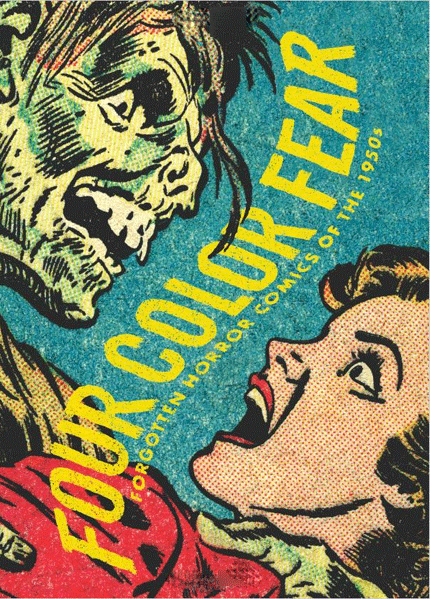
Which is why the slightly smaller and less flashy counterpart FOUR COLOR FEAR:  FORGOTTEN HORROR COMICS OF THE 1950s, edited by Greg Sadowski (Fantagraphics Books, $30), is the superior book in my estimation.  Even though the paper stock is slightly thinner, the volume is still in full color and attractively designed.  But the reason why FOUR COLOR FEAR has the edge is simply because the book literally piles complete full-color horror comics one after the other.  And it appears that all the strips have been digitally cleaned up to make them appear brand new with colors that pop out at us.  For me the glossy center section that reproduces front covers of comics is not essential.  Just presenting complete comic stories is the essence of what makes both these books essential.

And to be honest, entering the world of comic book horror circa the early 1950s is a rather rude awakening.  First, and most surprising, is the fact that most of these comic stories are not actually geared for children, at least not the eight-year-old variety.  This world is one of damnation and redemption and fosters an Old Testament morality.  The principal characters are scientists, newlyweds, henpecked husbands, sexily attired femme fatales who appear as wives and girlfriends.  The stories often start with or feature a recurring dream, mostly nightmares, and they deal with the most unusual things.  Funeral parlors are on strike so corpses cannot be buried and they literally keep piling up.  For health reasons, nothing like this would be allowed to occur in real life, so perhaps this is the juvenile aspect, as children would accept all these ludicrous scenarios.  In these stories we enter the world of the carny, of the undertaker, of people who indulge in vices such as gambling and high stakes poker games (playing for one’s life is the norm in this world).  In stories such as “The Corpse That Came to Diner,” a newlywed couple is haunted by the suicide death of the wife’s rival for her love, who returns from the grave a ghoulish, rotting corpse and refuses to leave the lovers alone.  Of course there is a surprise twist at the very end. In other stories people make pacts with the devil and lose.  People sacrifice everything to achieve their life’s dream scientific discovery, only to find out that discovery is death.  In another story a murderer is haunted by the dead, rotting corpse of the man he killed, who no matter where the body is dumped, it always returns to the murderer’s room.  In a haunting yet ridiculous story, “The Brain-Bats of Venus,” we have flying pink monsters become the controlling brains of dead human corpses. These creatures sit on their now dead hosts’ human heads.  While the premise is silly, the story chills the bones and images of human corpses being maneuvered by blob monsters with tentacles is one for the ages.  And such audacity continues story after story, comic panel after panel.

In this pre-code comic book world, human victims are consumed and destroyed by any number of the Seven Deadly Sins.  Women are generally manipulative, seductive or downright evil.  Or, they play the other extreme, becoming the ideal trophy wife.  Men are punished physically and mentally for their indiscretions, and in this moral universe, there is no escaping punishment for crimes or sins committed.  Often the final panel is shocking, with rough justice being doled out by the bucketful (of blood).  In such a comic universe, no one gets away with bloody murder and instant Karma levels the playing field in often the most shocking, surprising and gruesome ways.

I must admit that I enjoyed THE HORROR! THE HORROR! And FOUR COLOR FEAR more than I believed possible.  I mean, these are stories 60 years old from comic books created for children.  But man, as an adult these stories still pack a wallop and their ironic sense of justice still brings both a shudder and smile to my intense eyes glued to each panel. No E.C. titles are included in either volume, but these second tier comics are the real deal!  Sit back, take your time (let that inner child out for a breath of fresh air) and enjoy!

Sunday, July 31, 2011

DEAD HOOKER IN A TRUNK: Deliciously Outrageous!


My wife Sue is now a regular columnist for FANGORIA, writing “Furious Femmes” every month, a column about women who make horror movies.  And of course Sue has been interviewing many of the women filmmakers and getting copies of their movies.   

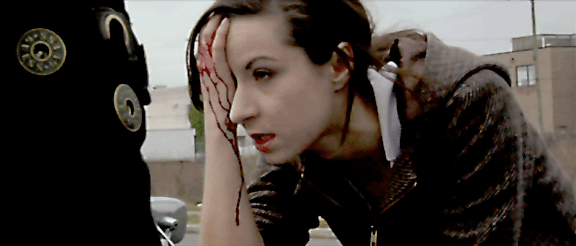
Vancouver twins Jen and Sylvia Soska have made their debuting feature DEAD HOOKER IN A TRUNK and it is total bliss cinema.  This film reminds me a great deal of the early, gonzo John Waters productions (during his PINK FLAMINGOS and FEMALE TROUBLE period), except the Soska film has better acting.  Every character is a stereotype (called Junkie, Geek, Badass, Goody Two Shoes) and the performances are either gritty/tough or wistful/tender, but every performance seems committed and real.  We believe in these rejects and ultimately come to care about them, as difficult as that may seem.  In this production, everyone rolls up his or her sleeves and pitches in.  Jen and Sylvia Soska star, write and direct and many of the other cast members (particularly C.J. Wallis) perform multiple duties.  And they all do wonderful jobs.

What I like is that this is a movie that could only have been made by young artists.  And I say this not because most of the cast is young, the action occurring at punk rock clubs and places where young folks frequent, and the musical score consists of buzz-sawing metal and punk rock.  Old farts could film young performers at a club and use a blaring rock score.  That’s not the point. But the film is filled to the brim with youthful enthusiasm, brashness, audacity and the Soska sisters do stuff that might seem silly or illogical in the hands of more seasoned professionals.  But they pull it off!  And who but the young would put themselves so far out there!


For instance, what mainstream or even cookie-cutter B production today would include the following sequence of events?  Geek (Jen Soska) is attacked from behind, pushed forward hard which knocks one of her eyes from the socket.  Her attacker bends down over her to make sure the eye is gone (it lies in a bloody heap to her side).  Geek picks herself up and holds her hand over her eye socket as blood flows down her hand and arm.  Soon she is declaring to her friends, calmly, all she needs are a few supplies, including two pieces of crisscrossing black tape to cover her eye socket, to fix her up.  In another sequence Junkie, who is nursing a slashed arm from a recent attack, is waving her arms while ranting, standing out in the street, when an 18-wheeler speeds past her ripping her wounded arm off.  Picking up the severed arm, her friends use tape and a needle and thread to reattach the arm, at least long enough to get Junkie to the hospital (which eventually occurs only after she drives herself to the emergency ward). Get the picture, outrageous stuff occurs at any moment and such cartoon violence is played straight.  Yet in another sequence, the one that explains how the hooker got to be dead before being stuffed into a car trunk, we watch as the killer brutally beats and then prepares to rape the hooker.  Such a sequence is difficult to watch and demonstrates how ultra-violence against women is one of the major themes of Soska cinema.  But we have such ping-ponging changes in tone, between goofy gore and violence and savage, disturbing female abuse.  But such diverse shifts prove to be interesting.

We have a constant barrage of running gags and homages to other movies thrown in for good measure.  For instance Badass (Sylvia Soska) is the one who is never wounded or hurt, while others around her lose their eyes, arms and Goody Two Shoes (C.J. Wallis), the Jesus freak who runs a church youth group, constantly bends over and vomits whenever the going gets tough.  So it is shocking, near the end of the film, when Badass returns to her apartment and is surprised by the killer-who-wears-a-hood who brutally punches her unconscious and subdues her by placing a plastic bag over her head.  When she awakens from this brutal attack, she recognizes her attacker immediately, a character we remember from earlier in the movie.  But just when we are lead to believe that Badass is indestructible, we now see her as vulnerable.  But earlier, in what I consider homage to Sam Raimi’s EVIL DEAD, we have Badass shoot the man who just disemboweled a drug dealer, his attacker slicing through his stomach and fondling his bleeding and now exposed intestines.  To put the pathetic dying man out of his misery, Badass thrusts her gun directly near the camera as we focus on her face.  We never see the man she shoots; instead, we hear the gun explode and see blood spattered all over her face in a quick instant.  This reminds me of similar sequences in EVIL DEAD where Ash (Bruce Campbell) has blood spattered all over his face.

Lastly, what I admire most about DEAD HOOKER IN A TRUNK is the manner by which the Soska sisters tell their story visually, opening the movie with a gonzo tracking shot that introduces both characters and the action with a minimum amount of dialogue for roughly the film’s first 10 minutes.  The movie opens as a girl arrives at the punk rock club in her car, jumping out of the car and running up the stairs to the club.  In an intimate surrounding, we see Junkie scream her little punk heart out as important characters either dance, speak in the shadows or walk past as we pan left or right.  We see a brief glimpse of the hooded killer, we see the strangely alive hooker wearing the red dress with side slits who will soon be dead (and the Soska sisters include a quick shot forward in time showing the hooker with a bloody punched face before we cut back to show her now smiling), we see the frightening Cowboy Pimp and other characters who only become important as the movie pushes ahead.  But with the blaring musical score, the quick cuts, stationary camera work alongside hand-held jerkiness, the movie impresses with a dramatic and totally visual (and auditory) introduction.  Fortunately this is only one of many “money” shots spread throughout the movie.

Yes, if we wanted to focus on flaws we could find them.  Hey, this is independent filmmaking at its most raw level.  DEAD HOOKER IN A TRUNK is more a labor of love emphasizing the joy of expression than it could ever be considered a commercial venture.  The Soska sisters, if they continue to hone their technique, will only make bigger and hopefully better movies.  Just as “Silent Bob” rose from independent to mainstream cinema, I hope to see the characters of Geek, Badass and Goody Two Shoes develop in future Soska movies. But for a debut, DEAD HOOKER IN A TRUNK is a film that lingers long after the music fades away and the credits fade to black.  This is a movie to seek out and enjoy, warts and all. 


Sunday, July 24, 2011

BORDERS CLOSES ITS DOORS: Is The Death of the Brick and Mortar Book/Music Store Upon Us?


I love bookstores almost as much as I love music stores.  Growing up I would often take a bus downtown (about a 45 minute ride) to go to General Records, an infamous downtown record store that carried all the albums and 45-rpm singles that mainstream record stores never carried.  I purchased albums such as the Jeff Beck Group’s TRUTH and THE ROD STEWART ALBUM, when Rod-the-Mod was a degenerate rocker, even before The Faces reformed around him. Most of the time I did not know what was newly released, so going through the vinyl bins made discovery exciting.

The same was true with bookstores.  I would gravitate to the magazine section or the movie or music book sections.  I even checked out some fiction.  But the anticipation of finding something fresh and original fueled my journeys.  And it was a tactile, hands-on experience!

But in those days that was the only way to find books, music and magazines. 

I have to admit when the Internet began to publish the release dates of upcoming music CDs and books, the discovery aspect of going to brick and mortal shops was greatly diminished.  Why take the time and spend the gas to travel a great distance to perhaps find something I wanted when the purchase of that specific book or record was one click way at home?  Also, for most Internet sales you may pay shipping but mostly you never paid sales tax.  And you save on gas and time.  There’s never enough time!

True, it never has been quite as much fun searching out books, magazines and CDs/downloads online as it was venturing to overstuffed and crowded shops with other fans that loved what you loved, intermingling with knowledgeable, enthusiastic salespeople (who usually were fans themselves).  But searching online or in person is still searching (and think how easy it has become to sample the first few pages of a potential book buy or how convenient to hear sound samples of new albums, privately, online).

The bottom line is this.  The way people read and listen to music today has changed, so the manner in which we browse, sample and buy has also changed.  As electronic gadgets such as the iPod, iPad, Smartphone and other devices steal shelf space formerly devoted to books and CDs, shopping online has become more and more important and, dare I say, necessary.

For instance my friend Paul Krueger does not own a computer, and by the time he gave up trying to find the newly released Blu-ray of THE EGYPTIAN in brick and mortal stores, the movie was out of print (it was limited to 3,000 copies).  For those of us who shop the Internet (and especially Amazon.com with their PRIME shipping and free download of DVDs), we can buy literally any movie, magazine or book that is in print, no matter how small its niche market or limited edition it may be.  EVERYTHING out there, even self-published or home garage record label releases, can be purchased, and most at very affordable, discounted prices.

Right now The Criterion Collection DVD/Blu-ray movies are 50% off list price at Barnes & Noble.  Of course I can drive to the nearest one, fight the traffic, spend the gas and walk a long distance to perhaps find that the movie I wanted to buy was not carried at this particular store or simply sold out.  Or I can access Barnes & Noble online, search out any movie I want to buy, even the ones that are temporarily out of stock, and have them delivered to my home at the 50% discount.

Perhaps I am getting old, but the convenience and sampling of unlimited titles is more and more appealing.  The fact that books and music are always sale priced and I never buy any book or CD/music download at list price is also very appealing.  And with Amazon.com Prime I pay $80 a year but get most everything shipped guaranteed second day shipping.  I can’t do better than that!  I make that $80 back by the third month and then ride the free wave the remainder of the year.

I always hated going to Best Buy on the Tuesday that a new DVD was released.  The major blockbuster titles were always there.  But sometimes when an older release came out, a so-called classic, the salesperson would check the shelf and say, wait, we may have copies “in back.”  Most times he would return empty-handed and state, sorry, it will most likely be on the truck Thursday, if not, it will definitely be here next week, or guaranteed the following week.  And of course I was expected to constantly be driving back to see if the film that should now be in my sweaty hands had arrived.  Of course the store only ordered 5 copies at most, so unless I got there early upon arrival, that title might sell out for good. Why waste time and energy!! I order the movie from my computer today and have it in my anxious hands in two days (or one day if I am lucky, which frequently occurs).

I admit I am sad when brick and mortal shops close.  I have fond memories of going to my favorite book and record shops over the years, and often I remember buying a specific Bob Dylan album at a specific store at a special time of the year.  But I also mourned the passing of the milkman delivering milk and juice to the front door.  I mourned the loss of going to the soda shop to buy freshly made sodas and milkshakes.  I mourned the loss of deejay-controlled radio stations. I mourned the passing of those fresh produce carts pulled by horses in the city where salesmen (here in Baltimore they were called “Arabbers” with an accent on the “A”) would yell out their stock and trade as they crept down the block.  And yes, I mourned the loss of the neighborhood ice cream man whose jingle-jangle merry melodies would beckon all the kids in the neighborhood outside on a warm summer night.  I mourned and continue to mourn all of that.  But change is inevitable and sometimes even for the best.

Anyway we look at it, we can still buy ice cream, milk, produce, books, magazines and music.  We just have to adapt to new ways of purchasing the old familiar.  And I won’t even talk about reading books on my Kindle or walking Buddy down the street listening to music on my iPod Classic.  That’s a story for another time.