Wednesday, February 1, 2012

FLESH AND BLOOD: Tinnell and Vokes Return with Hammer Horror


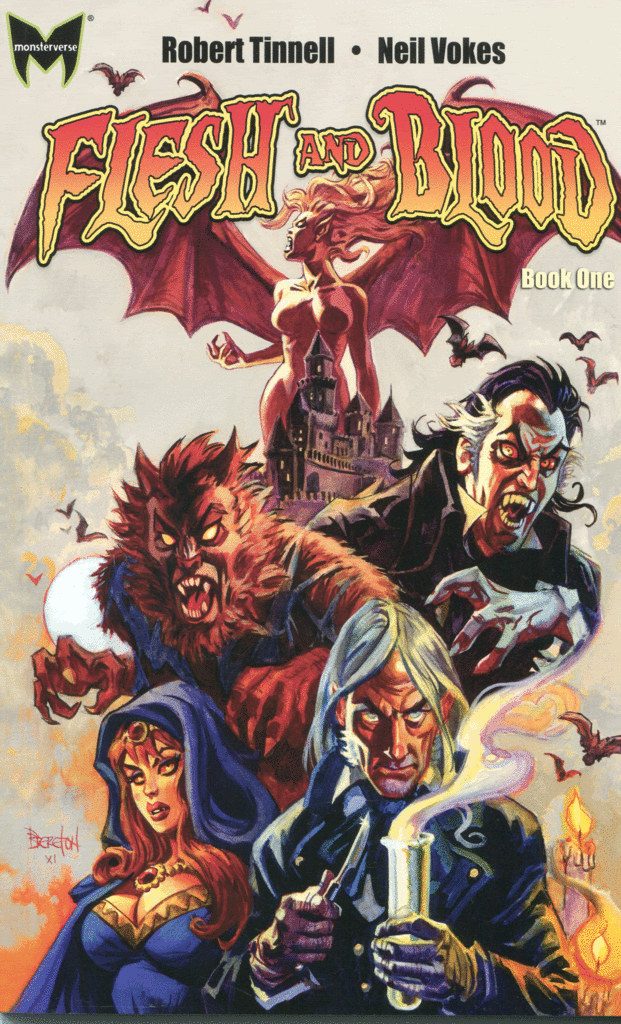
Neil Vokes, a professional comic artist with decades of experience, was wise to team up with Robert Tinnell, moviemaker and comic scripter.  Their THE BLACK FOREST (both parts) was a spectacular re-thinking of the classic horror film mythos from the 1930s and 1940s.  Rendered in deep monochrome strokes, THE BLACK FOREST was the ultimate Monster Rally as envisioned by the world of Universal Pictures.  So, reteaming once again, their newly inaugurated series FLESH AND BLOOD BOOK ONE, now in glossy Technicolor, recreates the ultimate Monster Rally as envisioned by the Hammer mythos of the 1950s, 1960s and 1970s.

FLESH AND BLOOD contains Gothic horror period detail and the characters are drawn with the Hammer horror look (wonderful caricatures of iconic characters, well-defined set decoration and lush period costuming).  The scope of the story, with its over-flowing cast of characters, would be much too opulent for the typical movie produced by the small independent production company in its heyday.  It was as though Tinnell and Vokes envisioned a mainstream, budget-be-damned ultimate Hammer production that would rip the walls off the sets and allow the Hammer vision to be expanded.  And that vision and dream is a worthy one.  However, it must be noted that Hammer horror is synonymous with claustrophobic set design, a limited cast of actors and an emphasis on character and performance.  In the unbridled Hammer world created here, Hammer seems to be the victim of its own success, existing in a parallel universe where the overblown replaces quiet subtlety.  But this is a graphic novel and visual excess is expected for the genre.  And wishing for a more mainstream, expensive Hammer production is and was a dream that many fans possess.

Book One is divided into multiple chapters, and the initial one, Primoris Cruor, gets the ball rolling with a 1970s vision of Hammer at its most sexual, with two young ladies rolling around in bed, only one of them a vampire attempting to seduce another innocent victim.  The intended victim’s father Ward-Baker restrains his daughter while vampire hunter The General tracks the evil Carmilla to her lair and there beheads her, putting an end to this predatory horror that reaches beyond death.  Claiming to be a Styrian, The General vows to exterminate the memory of Carmilla’s family, children, descendants, even the family home.  In many ways he appears to be even more evil than the vampires he seeks to destroy (to avenge his daughter’s death).  Cut to an asylum and a cell where a young medical student plays chess with Dr. Frankenstein. The enterprising General kidnaps both of them and promises Dr. Frankenstein a fresh start in life if he agrees to assist him. In the meanwhile, a Draculian vampire vows that Dr. Frankenstein, the General and all the vampire ravishers will be eliminated.  A very striking and dramatic beginning, I must say.

Chapter Two, Vindex Contrado, and the plot thickens.  Lawrence Ward-Baker writes a letter to his brother-in-law Horst to apologize for not believing his warning about the threat of the supernatural, the threat of Styria, which lead to the death of Horst’s sister and Ward-Baker’s wife.  He writes that this same evil almost cost the life of his daughter Laura.  Ward-Barker writes of his guilt over his behavior and asks for forgiveness.  Horst, since his sister’s death, has become an iconic monster-slayer and panel after panel of comic art attests to this scenario.  Into this mix comes another lesbian vampire seduction sequence, this time between two lovelies Katya and Greta.  But one of the vampires is captured by the General and transported back to his laboratory, headed by Dr. Frankenstein.  Their goal is to create a disease to eradicate vampirism.  Of course the young medical student Abraham and Laura become soul mates and the love interest of our tale. In the meanwhile, the vampires have gotten word of the experiments conducted by Frankenstein and the undead prepare to strike back.

By the time of Chapter Three, Refero, young Laura and Abraham confess their intentions to ask Laura’s father to allow them to wed, but local rowdies descend and threaten the lives of the young lovers.  However Laura’s uncle Horst, moved by Ward-Baker’s letter to him, appears on the scene to rescue Laura and violently dispatch the tormentors.  In the meanwhile Frankenstein is injecting his vampire subject with human blood tainted with garlic and other ingredients to study the manner in which the vampire’s body works, with the idea of developing a plague as the end result.  During these experiments Horst and Ward-Baker are reunited.  In the chapter’s end a naked Laura seduces Abraham, but her manners and words suggest that she may have been contaminated by vampire blood, confessing an inability to feel the love she has for Abraham.

In the final Chapter Four, Praelium De Sanguis, there is precious little dialogue and plenty of graphic action as the human’s worthy adversary king vampire is revealed to be Vlad (Count Dracula) who gushes to deliver lines such as “Frankenstein must be destroyed” and “bring me the head of Frankenstein.”  As suggested, Laura has been infected with the disease of vampirism and turns against her human lover and family.  Ward-Baker sadly dies in the human-vampire war, but worthy Abraham reveals that his last name is Van Helsing and the surviving humans vow to continue the battle … in Book Two!

I was impressed by Neil Voke’s always-transcendent artwork, sometimes gushing in vivid Technicolor hues, and at other times draped in duo-tone subdued hues of blues and brown.  Of course Voke’s depiction of Dr. Frankenstein resembles a gaunt Peter Cushing, although his Dracula is a typical comic book exaggerated vampire with fangs, demonic eyes and full mane of hair.  The art is visually spectacular and seems to be his most fully realized in his collaboration with Robert Tinnell.  Tinnell’s script, always action-packed but heavy with characterization and emotion, sometimes tries to plow ahead too dramatically, one sequence immediately butted onto the end of a dramatic one that followed before.  It’s as though the goal of Tinnell and Vokes was to make every panel visually explosive and to keep the plot moving rapidly ahead (akin to the editing of today’s movies where one whirlwind sequence follows another and the audience hardly has time to collect its breath).  In the classic Hammer films, scriptwriters such as Jimmy Sangster and Anthony Hinds allowed action to develop from character and these Gothic masterpieces are allowed some breathing space and quiet moments.  Not that Tinnell’s script does not allow for such quiet moments, but sometimes the comic seems to be patterned after today’s UNDERWORLD, BLADE and VAN HELSING-style cinema, where sensory overkill and hyperkinetic pacing undo the more leisurely pacing of the great Hammer classics.  Perhaps the duo compromised to the demands of what works in graphic novels today. But for an obvious tribute to classic Hammer films, FLESH AND BLOOD sometimes comes off as too modern and fast-paced for its own good.  I would have liked the tribute to play homage more to the Hammer classics of the 1950s and 1960s than to the more sexually explicit and violent Hammer films of the 1970s.  But then again in today’s market perhaps nudity and sex is de rigor by the demands of the marketplace.  But I have to admit that the lesbian vampire shenanigans are deftly handled and beautifully rendered.  But my Hammer reference points are geared more toward HORROR OF DRACULA and REVENGE OF FRANKENSTEIN than THE VAMPIRE LOVERS and LUST FOR A VAMPIRE.  But that’s just me.

Bottom line, FLESH AND BLOOD BOOK ONE is a smashing success, not simply because of its outrageous and deliciously designed art, not simply because of its loving tribute to Hammer in the plot, but because of its subtleties—lines of dialogue that wink at its audience, graphic tributes to Hammer film icons, moments of quiet emotional intensity, etc.  I eagerly look ahead to the remaining “books” in the FLESH AND BLOOD series and recommend this graphic novel series to anyone who loves great horror comics and classic horror (especially Hammer) in general.  I thoroughly enjoyed this nostalgic trip and hope to return to this world again and again.  Robert Tinnell and Neil Vokes are revitalizing classic horror comics, and their work stands alongside the best the genre has ever produced.  Keep it coming, guys!

Wednesday, October 5, 2011

MIDNIGHT MARQUEE #78 ships by Halloween


We may not produce the most issues per year, but with MIDNIGHT MARQUEE #78 we are entering our 48th year of publication.  The latest issue, once again full size and full color, will be shipping around Halloween.  The 40-page issue plus covers will once again contain two feature articles and our regular editorial, book reviews and DVD/Blu-ray disc reviews.

The first feature article will be ALIEN:  IN SPACE NO ONE CAN HEAR YOUR PRIMAL SCREAM by Anthony Ambrogio.  This article began its genesis as an orally presented essay at a conference back in the 1980s, but the full essay has never seen publication.  As is Anthony’s style, the critical analysis looks at the relationship between the sexual predator alien, the victimized crew and Mother and demonstrates all the levels of psychological dependency, sexual tension and conflict that exist between the children (the crew) and their Mother (the ship’s onboard computer).  The analysis, while quite unique and serious, contains just enough of a sense of tongue-in-cheek humor that the piece never becomes too academic.  People have read numerous critiques on Ridley Scott’s horror classic over the decades, but I guarantee no one has read the insightful and unique interpretation that Ambrogio gives ALIEN in this fresh analysis.

Next up we feature Steven West’s THE HISTORY OF THE HORROR FILM PORTMANTEAU.  The so-called anthology horror films have been around since the Golden Age of Horror.  Going back as far as Germany’s 1919 EERIE TALES, FLESH AND FANTASY and DEAD OF NIGHT from the 1940s, TALES OF TERROR and BLACK SABBATH from the 1960s, not to forget the entire string of anthology movies produced by Amicus during the 1960s and 1970s (DR. TERROR’S HOUSE OF HORRORS, TORTURE GARDEN, THE HOUSE THAT DRIPPED BLOOD, TALES FROM THE CRYPT, ASYLUM, etc.), finally arriving to investigate films such as CREEPSHOW, TALES FROM THE HOOD, SNOOP DOGG’S HOOD OF HORROR to finish with TRICK ’r TREAT of a few years ago.  Of course these titles only scratch the surface, as many more portmanteau titles are included in West’s research.  Most of the above movies are very familiar, but how many people know CRADLE OF FEAR, TRAPPED ASHES, THE THREE FACES OF FEAR, TERROR TRACT, BANGKOK HAUNTED, movies also covered in the West’s article.

Both feature articles are profusely illustrated with full color posters, photos and advertising that pops from the page. 

As mentioned we editorialize and review the latest in genre books and DVDs.

The 40-page full-color magazine (printed on special thick white paper that was formulated for superior color reproduction) sells for $10 plus $1 for shipping.  If priority mail shipping is preferred, add $6 for shipping.

Again, the issue will be shipping by Halloween (or a little before).  We accept all credit cards, PayPal and money orders/checks.  Check out our website at:

http://www.midmar.com

Sunday, October 2, 2011

THE JOYS OF UNCENSORED HORROR COMIC BOOKS


One of the joys of my childhood was taking that half-mile trek up Belair Road to this little drugstore that had the best magazine and comics rack in the area.  It was here that I purchased all the early issues of FAMOUS MONSTERS, CASTLE OF FRANKENSTEIN and all the D.C. and Marvel comics.  I even enjoyed such stuff as Archie and Little Lulu and other “safe” comic entertainment.  I just enjoyed the smell of comic book ink and loved sitting in my back yard, under the cherry tree, reading page upon page of fascinating stories brought to life with imaginative art and garish coloring.

I did not discover the joy of comics until I was seven or eight years old, and that was in 1957-1958.  Because of the harsh comic code that destroyed E.C. horror comics a few years earlier, I was not really a fan of the current horror comics, simply because they were not horrific enough.  As a child, I did not know the politics that castrated the genre a few short years earlier and laid to rest the Golden Age of horror comic books.  Since my childhood I discovered E.C. comics via published reproductions, and I even managed to buy a few of the original issues.  To me the Amicus and George Romero movie adaptations did not do justice to the artistry of the original horror comic books.  They thrived best as their own genre.

As a horror movie aficionado, I loved the classic Universal horror movies. I also discovered and loved the B studios and their horror output. PRC, Monogram and Columbia produced low-budget by-the-seat-of-their-pants products that were far less sophisticated yet still great fun.

The same thing occurred with the classic horror comics.  Yes, E.C. was top dog of the litter, but many comparable companies produced excellent horror comics during the early 1950s, comic titles that are almost forgotten today but rival the E.C. brand in scripting/story and art.  These are comics worthy of re-evaluation.

So in the past few months I have been devouring two wonderful trade paperbacks that not only give the history of the Golden Age of horror comic books, but also reproduce many of the best stories, in garish color.

The first volume is called THE HORROR! THE HORROR!  COMIC BOOKS THE GOVERNMENT DIDN’T WANT YOU TO READ by R.L. Stine and Jim Trombetta (Abrams ComicArts, $30).  This is one of those lush, full color, oversized trade paperbacks that simulates the case bound look and feel of a dust jacket by having the heavy-stock cover fold back underneath.  The book contains tons of text detailing the history of horror comic books, and perhaps too much space is devoted to reprinting sample two-page spreads from some wonderful stories where we wish we could read the entire comic.  Lots of comic covers are reproduced as well.  But the entire purpose of the book is reproducing entire comic stories in their entirety and this becomes the chief strength of THE HORROR!  THE HORROR!  Even the reproduction reflects the age of the comics with yellowish paper now replacing pure white. Even some of the flaws of aging are reproduced as well.  The book’s layout and visual audacity is beautiful, worthy of winning a graphic design award, but somehow all I wanted was to read the comics stories themselves.  No need for interviews, historic significance, facts, etc.  The comic art says it all.

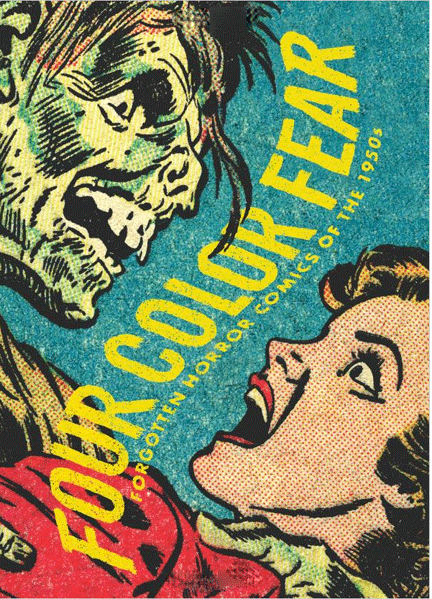
Which is why the slightly smaller and less flashy counterpart FOUR COLOR FEAR:  FORGOTTEN HORROR COMICS OF THE 1950s, edited by Greg Sadowski (Fantagraphics Books, $30), is the superior book in my estimation.  Even though the paper stock is slightly thinner, the volume is still in full color and attractively designed.  But the reason why FOUR COLOR FEAR has the edge is simply because the book literally piles complete full-color horror comics one after the other.  And it appears that all the strips have been digitally cleaned up to make them appear brand new with colors that pop out at us.  For me the glossy center section that reproduces front covers of comics is not essential.  Just presenting complete comic stories is the essence of what makes both these books essential.

And to be honest, entering the world of comic book horror circa the early 1950s is a rather rude awakening.  First, and most surprising, is the fact that most of these comic stories are not actually geared for children, at least not the eight-year-old variety.  This world is one of damnation and redemption and fosters an Old Testament morality.  The principal characters are scientists, newlyweds, henpecked husbands, sexily attired femme fatales who appear as wives and girlfriends.  The stories often start with or feature a recurring dream, mostly nightmares, and they deal with the most unusual things.  Funeral parlors are on strike so corpses cannot be buried and they literally keep piling up.  For health reasons, nothing like this would be allowed to occur in real life, so perhaps this is the juvenile aspect, as children would accept all these ludicrous scenarios.  In these stories we enter the world of the carny, of the undertaker, of people who indulge in vices such as gambling and high stakes poker games (playing for one’s life is the norm in this world).  In stories such as “The Corpse That Came to Diner,” a newlywed couple is haunted by the suicide death of the wife’s rival for her love, who returns from the grave a ghoulish, rotting corpse and refuses to leave the lovers alone.  Of course there is a surprise twist at the very end. In other stories people make pacts with the devil and lose.  People sacrifice everything to achieve their life’s dream scientific discovery, only to find out that discovery is death.  In another story a murderer is haunted by the dead, rotting corpse of the man he killed, who no matter where the body is dumped, it always returns to the murderer’s room.  In a haunting yet ridiculous story, “The Brain-Bats of Venus,” we have flying pink monsters become the controlling brains of dead human corpses. These creatures sit on their now dead hosts’ human heads.  While the premise is silly, the story chills the bones and images of human corpses being maneuvered by blob monsters with tentacles is one for the ages.  And such audacity continues story after story, comic panel after panel.

In this pre-code comic book world, human victims are consumed and destroyed by any number of the Seven Deadly Sins.  Women are generally manipulative, seductive or downright evil.  Or, they play the other extreme, becoming the ideal trophy wife.  Men are punished physically and mentally for their indiscretions, and in this moral universe, there is no escaping punishment for crimes or sins committed.  Often the final panel is shocking, with rough justice being doled out by the bucketful (of blood).  In such a comic universe, no one gets away with bloody murder and instant Karma levels the playing field in often the most shocking, surprising and gruesome ways.

I must admit that I enjoyed THE HORROR! THE HORROR! And FOUR COLOR FEAR more than I believed possible.  I mean, these are stories 60 years old from comic books created for children.  But man, as an adult these stories still pack a wallop and their ironic sense of justice still brings both a shudder and smile to my intense eyes glued to each panel. No E.C. titles are included in either volume, but these second tier comics are the real deal!  Sit back, take your time (let that inner child out for a breath of fresh air) and enjoy!