Wednesday, August 8, 2012

Mickey Spillane's MIKE HAMMER Comes to Television, 1950s Style!


Last year A&E/NBC Universal released to DVD the complete two-year run of MICKEY SPILLANE’S MIKE HAMMER TV series, broadcast from 1956-1959.  The series was a product of tame 1950s television and could not duplicate the hardboiled antics that occurred in the Spillane hard-boiled literature.  Many people smile when they learn that Darren McGavin, the “Old Man” from the classic CHRISTMAS STORY and the beloved, eccentric Carl Kolchak from THE NIGHT STALKER TV movies and series, was cast, in his prime, as one of literature’s greatest private detectives.  However, defying all odds, the series is a gritty delight and McGavin is excellent in his portrayal of the independent, vigilante P.I. who works closely with the police, namely his worthy adversary and friend Pat Chambers (Bart Burns).  Episodes only ran 25 minutes, making it difficult to tell dirty little crime stories with substance in so short a time. But Revue/Universal did a fantastic job back in the day.  Unfortunately, the series never became a TV hit on the level of THE NAKED CITY, THE UNTOUCHABLES or M SQUAD, but it deserved to join those icons of television crime classics.

The series lasted 78 episodes, improving as it went along.  The crowning final four episodes of season one introduced the superior second season, where the visuals became bloodier and the scripts crisper and more complex.  Looking at the credits during the relatively short run, we find directors such as Boris Sagal, William Witney, John English, Earl Bellamy and Ray Nazarro working regularly (Sagal directed 25 episodes).  Even though Mickey Spillane wrote none of the scripts, tight little scenarios were created by the likes of Frank Kane, Steven Thornley, B.X. Sanborn and Evan Hunter, among others.  Both rising and established stars appearing on the series included Lorne Greene, Andrea King, Angie Dickinson, Ruta Lee, John Hoyt, Paul Dubov, Walter Reed, Robert Fuller, Yvette Vickers, Virginia Gregg, DeForest Kelley, Pat O’Malley and Mike Connors.  And the jazzy music score created by multiple composers (Maury Leaf scored 33 episodes and Harold V. Johnson 14) supports the smoky noir tone.

So how do we truncate the complex plots crafted by Spillane and boil teleplays down to less than half an hour per week?  How do we dumb down the literature yet still retain most of the characters’ integrity?  Surprisingly, the series did a marvelous job of retooling the series for a 1950s family audience, but that family had better get quickly acquainted with violent fist fights, bloody bullet wounds and heated battles to the death with hand guns.  For its time, MIKE HAMMER was quite envelop-pushing.  In many episodes a gunman fires two or three shoots at Hammer, who dodges the bullets or sometimes gets winged.  But instead of looking the other way, Hammer, whether he truly needs to or not, returns the gunfire, usually killing the villain without a second thought.  While McGavin’s Mike Hammer is playful, comical and wears a smile or pleasant face, he is not hesitant about cleaning up his city by sending criminals to the morgue.

The first reason for the show’s success was Darren McGavin’s starring performance.  Yes, the most beautiful women were too instantly attracted to the rugged but not legitimately handsome star that wore a rumbled suit, loose tie and battered hat. However, McGavin’s performance was instilled with integrity and a sense of fair play and always doing the right thing.  In his clichéd but almost expected crusty voice-over narration, Hammer reveals his love for New York City and the old neighborhoods.  Being a product of the city, he goes on a limb multiple times for old childhood friends who are now in trouble with the law or else need help for friends or relatives missing or in “The Tombs,” the New York prison system.  The actual New York location photography is quite impressive and brings a gritty, urban setting to frame the dark crime stories.  Even though most of the action occurs on cheap television sets, the location shots add budget and scope to the proceedings.  And many episodes begin with McGavin’s narration that creates lovely noir love letters to the city he embodies.  And to me this is where the TV series comes closest to the literature, because most of the Mike Hammer novels are themselves touching homages to The Big Apple.

But even though Darren McGavin might be relatively too slight and jocular to represent the true Mike Hammer created in the literature, McGavin does a mighty fine job with the material handed him.  For instance, McGavin constantly cocks a half-smile—some might say a sneer—during every episode.  And this blending, this ying and yang, of showing disdain for humanity and compassion at the same time sits at the heart of the performance.  Hammer constantly returns to his boyhood neighborhood and reunites with relatives, neighbors and friends he left behind years ago.  In reconnecting, Hammer sometimes finds himself in the company of people with a similar value system, but often he discovers that these faces from his past have become tainted, seduced by circumstance, want or greed, and that his life is sometimes put in jeopardy because of his trust and need to help the needy.  And while Hammer always seems like the dutiful P.I. working on retainer for the good of his client, he often figures out his client’s dirty little secrets before all the facts are in place.  It is Hammer’s special ability to read people and use his intuitive abilities to solve the case often before all the evidence has been collected (which constantly angers his police pal Pat Chambers).  He allows himself to be physically attracted to beautiful clients and even lose himself in one or two passionate kisses, but at the same time his hand is only inches away from his shoulder holster and he is not shy about roughing up any black window who tries to seduce him to get the upper hand.  He is a character who appears to truly enjoy his work and he is always bouncing from one part of the city to another, speaking to one suspect after another, never tiring, never complaining (complaining is what he does when he has no case and is forced to pay his bills or clean up his office), never losing his focus or sense of humor.  For all the hard working dads of the late 1950s, Hammer is the perfect escapist hero for that generation.

In contrast, his nasty other side can be found in his relationship with recurring character Geta, played by Vito Scotti.  Geta runs a little soda shop, but the stereotypical Italian is the local source to purchase illegal guns. He is an informant both to the criminal world and the police. He is the type of weasel that always plays one side against the other.  When Hammer enters Geta’s shop for “a name,” Geta always nervously clams up and sputters that he knows nothing.  But it is Hammer’s not so playful interrogation blended with veiled threats, always delivered with an all-knowing smile on his face, that establishes this good cop/bad cop relationship.  Hammer usually slaps Geta around the ears, pokes him in the chest or punches him in the stomach to loosen up the sneak’s lips.  The audience can tell in seconds that Geta cannot be trusted and that he would say anything to save his skin, and in a few episodes Hammer leaves the poor guy’s soda shop in shambles, with glasses broken, tables overturned and chairs smashed to bits.  But we all know that Hammer will be back, that sooner or later Geta will know something that he is not willingly able to share, but that Hammer’s persuasive methods will prevail.

One of the better episodes, Pen Pals (from season two), really explores the film noir morality inherent in these 25-minute morality plays. In this episode, Holly (Angela Austin), wife to ex-con Marty (Mike Connors), hires Mike Hammer because her husband is in some type of trouble. Marty has been straight since his release from jail, running a small neighborhood antiques shop, but two ex-cons from Marty’s past threaten to expose his criminal past unless he works with them to rob nearby neighborhood shops.  The thugs Simmons (Ed Kemmer, star of television’s Space Patrol) and Luger (Dort Clark) plan to rob Marty’s store first, to make him appear to be the innocent victim after which more and more shops will be robbed.  The conflicted and basically honest Marty is afraid to tell the truth to Hammer and even his wife. Hammer explains to the dense Marty that after the criminals rob his shop, Marty and his wife will know too much about the criminal operation to be allowed to live.  But Marty is too scared to think straight.  In the hard-hitting drama, Hammer tries to use his own muscle to force the hoods to leave Marty alone, but instead they kidnap Marty’s wife and get even more of a grip on the nervous shopkeeper.  In the film’s climax Marty finally comes around and allows Hammer and police protection to be on the scene the night of the robbery, and the show ends in a hail of gunfire as the good guys prevail.  The curious thing is that Hammer acts just as tough and roughs up the good guy as much as he does the two criminals.  Hammer, very street wise, knows how to play the cards dealt him, but the problem is the fear that crime instills in the hearts and minds of the innocent, making even seasoned ex-cons play right into the criminals’ hands.  So we have the morally confused Marty debate what scares him the most—the fear that he might go back to prison, concern for the life of his kidnapped wife or the financial success of his small business.  It is never an easy decision for the stressed out victim every week, but for Mike Hammer it’s always an easy decision because he sees right through to the heart of the situation.  Hammer, unlike many of his clients, has the courage to do the right thing without hesitation, whether that involves walking directly into the criminal’s lair, slapping a bad guy around, fighting with his fists for his life or charging into a deadly room with his gun blazing.  And often when an underprivileged client waves money his way, Hammer tells the client to hold on to the money.  Even with wealthy clients he sometimes tells them to pay him what they think he’s worth.
Perhaps the best episode and one that demonstrates how complex the scenario can become in a mere 25 minutes is season two’s 10th episode, According to Luke (referring to the villain Luke Lund and to the Biblical scripture from the Gospel of Luke pertaining to an eye for an eye).  Former New York mobster Luke Lund (Tom Neal, who starred in the film noir classic Detour, appears here in his final performance) has relocated to Shale City, near San Francisco, as a supposed legit land developer.  It seems five years earlier Lund was responsible for the murder of an innocent girl and the only witness, Al Kruger (Tom Gleason), was paid off handsomely by Lund to keep his mouth shut.  Kruger still continues to be paid off for his continued silence.  Mike Hammer represented the murdered girl and wants justice. Lund’s hired gun from the East Coast, Lloyd Barnum (Lewis Charles), is told by Lund to phone Hammer and reveal where he can find Kruger.  The potentially violent reunion occurs at Kruger’s hotel, but before Hammer beats a confession from Kruger, a corrupt cop Dacon (Joseph Mell) intervenes.  Lund finally phones Hammer and tells him to come to his gated mansion that night, but when Hammer arrives the hidden Barnum knocks Hammer unconscious near the front door. Hammer awakens almost an hour later outside of town, left by the side of a rural road. Dacon soon brings Hammer to the station for questioning, revealing that Kruger was beaten and shot dead … with Hammer’s pistol.  Hammer smells the frame, overpowers the soft cop, and finds Barnum in his hotel room.  There we observe the beast within nice guy Hammer as he takes his open hand and almost slaps the gangster to death.  Finally, with blood flowing freeing from both his nose and ear, Barnum confesses and implicates Dacon as being in on the murder and frame.  As Hammer is ready to leave, Barnum dives for a gun hidden in the sofa, and Hammer shoots him to death, having killed the only man who can clear him.  Using Lund’s sexy and honest secretary, Hammer lures Lund to Barnum’s hotel room and agrees to back off implicating Lund as long as Hammer’s pistol is no longer associated with Kruger’s death.  The crafty mobster agrees, but as Hammer is about to exit the small hotel, he stops dead in his tracks and backtracks to kick in the door to Barnum’s room, catching Lund signaling someone outside.  Hammer tells the thug that he knows Dacon is outside ready to gun him down, but he forces Lund to change coats and hats with him, that Lund can “get it” from him right here or Lund can take his chances by walking outside.  Outside Lund screams, “Dacon, it’s me, Lund, it’s Lund” as Dacon opens fire and kills him.  Hammer comes running outside as Dacon flees, Hammer firing and wounding the cop.  Police sirens are approaching and Hammer’s voice-over ends the superb episode with the suggestion that the police will get the picture when they arrive, but not the frame, referring to his own quick escape.  Director Earl Bellany, working from one of many scripts written by Steven Thornley, brings out the trapped beast in Mike Hammer who constantly reminds himself of the fool he’s been played for as he desperately tries to clear his name before it’s too late.  The tension generated and all the twists and turns make the 25 minutes just fly by.

Television and crime series have evolved since the late 1950s, but Darren McGavin really breathes life into the character of Mike Hammer, transforming Hammer into a lovable rogue and babe magnate with that sly wink in his eye.  McGavin’s Hammer might not have been Spillane’s, but the television series kept the action flowing, the guns blazing and the fists flying.  It is a mostly forgotten series that deserves to be rediscovered. 


Wednesday, February 1, 2012

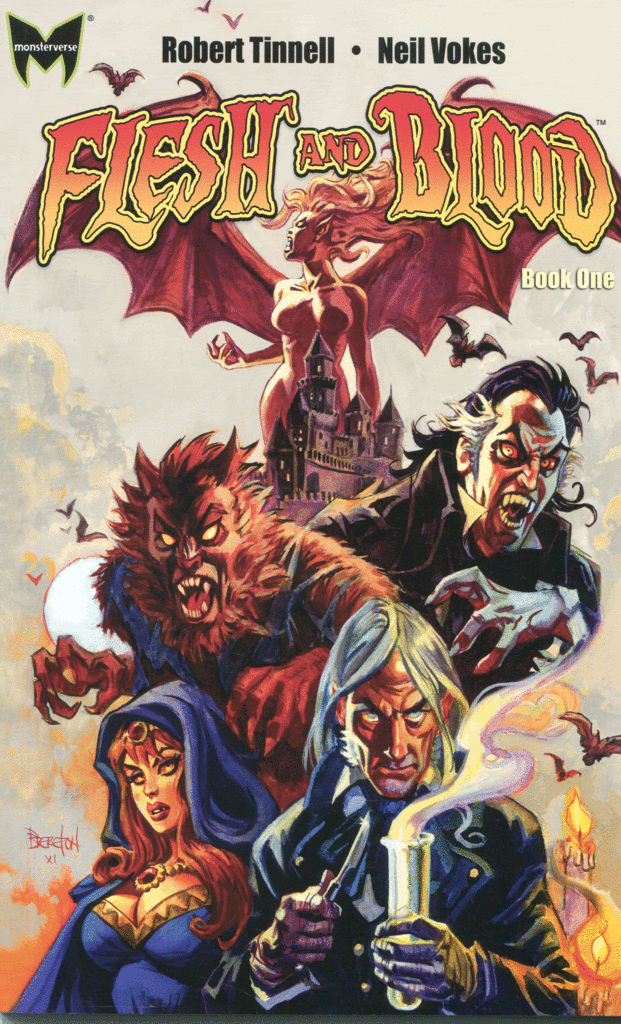
FLESH AND BLOOD: Tinnell and Vokes Return with Hammer Horror


Neil Vokes, a professional comic artist with decades of experience, was wise to team up with Robert Tinnell, moviemaker and comic scripter.  Their THE BLACK FOREST (both parts) was a spectacular re-thinking of the classic horror film mythos from the 1930s and 1940s.  Rendered in deep monochrome strokes, THE BLACK FOREST was the ultimate Monster Rally as envisioned by the world of Universal Pictures.  So, reteaming once again, their newly inaugurated series FLESH AND BLOOD BOOK ONE, now in glossy Technicolor, recreates the ultimate Monster Rally as envisioned by the Hammer mythos of the 1950s, 1960s and 1970s.

FLESH AND BLOOD contains Gothic horror period detail and the characters are drawn with the Hammer horror look (wonderful caricatures of iconic characters, well-defined set decoration and lush period costuming).  The scope of the story, with its over-flowing cast of characters, would be much too opulent for the typical movie produced by the small independent production company in its heyday.  It was as though Tinnell and Vokes envisioned a mainstream, budget-be-damned ultimate Hammer production that would rip the walls off the sets and allow the Hammer vision to be expanded.  And that vision and dream is a worthy one.  However, it must be noted that Hammer horror is synonymous with claustrophobic set design, a limited cast of actors and an emphasis on character and performance.  In the unbridled Hammer world created here, Hammer seems to be the victim of its own success, existing in a parallel universe where the overblown replaces quiet subtlety.  But this is a graphic novel and visual excess is expected for the genre.  And wishing for a more mainstream, expensive Hammer production is and was a dream that many fans possess.

Book One is divided into multiple chapters, and the initial one, Primoris Cruor, gets the ball rolling with a 1970s vision of Hammer at its most sexual, with two young ladies rolling around in bed, only one of them a vampire attempting to seduce another innocent victim.  The intended victim’s father Ward-Baker restrains his daughter while vampire hunter The General tracks the evil Carmilla to her lair and there beheads her, putting an end to this predatory horror that reaches beyond death.  Claiming to be a Styrian, The General vows to exterminate the memory of Carmilla’s family, children, descendants, even the family home.  In many ways he appears to be even more evil than the vampires he seeks to destroy (to avenge his daughter’s death).  Cut to an asylum and a cell where a young medical student plays chess with Dr. Frankenstein. The enterprising General kidnaps both of them and promises Dr. Frankenstein a fresh start in life if he agrees to assist him. In the meanwhile, a Draculian vampire vows that Dr. Frankenstein, the General and all the vampire ravishers will be eliminated.  A very striking and dramatic beginning, I must say.

Chapter Two, Vindex Contrado, and the plot thickens.  Lawrence Ward-Baker writes a letter to his brother-in-law Horst to apologize for not believing his warning about the threat of the supernatural, the threat of Styria, which lead to the death of Horst’s sister and Ward-Baker’s wife.  He writes that this same evil almost cost the life of his daughter Laura.  Ward-Barker writes of his guilt over his behavior and asks for forgiveness.  Horst, since his sister’s death, has become an iconic monster-slayer and panel after panel of comic art attests to this scenario.  Into this mix comes another lesbian vampire seduction sequence, this time between two lovelies Katya and Greta.  But one of the vampires is captured by the General and transported back to his laboratory, headed by Dr. Frankenstein.  Their goal is to create a disease to eradicate vampirism.  Of course the young medical student Abraham and Laura become soul mates and the love interest of our tale. In the meanwhile, the vampires have gotten word of the experiments conducted by Frankenstein and the undead prepare to strike back.

By the time of Chapter Three, Refero, young Laura and Abraham confess their intentions to ask Laura’s father to allow them to wed, but local rowdies descend and threaten the lives of the young lovers.  However Laura’s uncle Horst, moved by Ward-Baker’s letter to him, appears on the scene to rescue Laura and violently dispatch the tormentors.  In the meanwhile Frankenstein is injecting his vampire subject with human blood tainted with garlic and other ingredients to study the manner in which the vampire’s body works, with the idea of developing a plague as the end result.  During these experiments Horst and Ward-Baker are reunited.  In the chapter’s end a naked Laura seduces Abraham, but her manners and words suggest that she may have been contaminated by vampire blood, confessing an inability to feel the love she has for Abraham.

In the final Chapter Four, Praelium De Sanguis, there is precious little dialogue and plenty of graphic action as the human’s worthy adversary king vampire is revealed to be Vlad (Count Dracula) who gushes to deliver lines such as “Frankenstein must be destroyed” and “bring me the head of Frankenstein.”  As suggested, Laura has been infected with the disease of vampirism and turns against her human lover and family.  Ward-Baker sadly dies in the human-vampire war, but worthy Abraham reveals that his last name is Van Helsing and the surviving humans vow to continue the battle … in Book Two!

I was impressed by Neil Voke’s always-transcendent artwork, sometimes gushing in vivid Technicolor hues, and at other times draped in duo-tone subdued hues of blues and brown.  Of course Voke’s depiction of Dr. Frankenstein resembles a gaunt Peter Cushing, although his Dracula is a typical comic book exaggerated vampire with fangs, demonic eyes and full mane of hair.  The art is visually spectacular and seems to be his most fully realized in his collaboration with Robert Tinnell.  Tinnell’s script, always action-packed but heavy with characterization and emotion, sometimes tries to plow ahead too dramatically, one sequence immediately butted onto the end of a dramatic one that followed before.  It’s as though the goal of Tinnell and Vokes was to make every panel visually explosive and to keep the plot moving rapidly ahead (akin to the editing of today’s movies where one whirlwind sequence follows another and the audience hardly has time to collect its breath).  In the classic Hammer films, scriptwriters such as Jimmy Sangster and Anthony Hinds allowed action to develop from character and these Gothic masterpieces are allowed some breathing space and quiet moments.  Not that Tinnell’s script does not allow for such quiet moments, but sometimes the comic seems to be patterned after today’s UNDERWORLD, BLADE and VAN HELSING-style cinema, where sensory overkill and hyperkinetic pacing undo the more leisurely pacing of the great Hammer classics.  Perhaps the duo compromised to the demands of what works in graphic novels today. But for an obvious tribute to classic Hammer films, FLESH AND BLOOD sometimes comes off as too modern and fast-paced for its own good.  I would have liked the tribute to play homage more to the Hammer classics of the 1950s and 1960s than to the more sexually explicit and violent Hammer films of the 1970s.  But then again in today’s market perhaps nudity and sex is de rigor by the demands of the marketplace.  But I have to admit that the lesbian vampire shenanigans are deftly handled and beautifully rendered.  But my Hammer reference points are geared more toward HORROR OF DRACULA and REVENGE OF FRANKENSTEIN than THE VAMPIRE LOVERS and LUST FOR A VAMPIRE.  But that’s just me.

Bottom line, FLESH AND BLOOD BOOK ONE is a smashing success, not simply because of its outrageous and deliciously designed art, not simply because of its loving tribute to Hammer in the plot, but because of its subtleties—lines of dialogue that wink at its audience, graphic tributes to Hammer film icons, moments of quiet emotional intensity, etc.  I eagerly look ahead to the remaining “books” in the FLESH AND BLOOD series and recommend this graphic novel series to anyone who loves great horror comics and classic horror (especially Hammer) in general.  I thoroughly enjoyed this nostalgic trip and hope to return to this world again and again.  Robert Tinnell and Neil Vokes are revitalizing classic horror comics, and their work stands alongside the best the genre has ever produced.  Keep it coming, guys!

Wednesday, October 5, 2011

MIDNIGHT MARQUEE #78 ships by Halloween


We may not produce the most issues per year, but with MIDNIGHT MARQUEE #78 we are entering our 48th year of publication.  The latest issue, once again full size and full color, will be shipping around Halloween.  The 40-page issue plus covers will once again contain two feature articles and our regular editorial, book reviews and DVD/Blu-ray disc reviews.

The first feature article will be ALIEN:  IN SPACE NO ONE CAN HEAR YOUR PRIMAL SCREAM by Anthony Ambrogio.  This article began its genesis as an orally presented essay at a conference back in the 1980s, but the full essay has never seen publication.  As is Anthony’s style, the critical analysis looks at the relationship between the sexual predator alien, the victimized crew and Mother and demonstrates all the levels of psychological dependency, sexual tension and conflict that exist between the children (the crew) and their Mother (the ship’s onboard computer).  The analysis, while quite unique and serious, contains just enough of a sense of tongue-in-cheek humor that the piece never becomes too academic.  People have read numerous critiques on Ridley Scott’s horror classic over the decades, but I guarantee no one has read the insightful and unique interpretation that Ambrogio gives ALIEN in this fresh analysis.

Next up we feature Steven West’s THE HISTORY OF THE HORROR FILM PORTMANTEAU.  The so-called anthology horror films have been around since the Golden Age of Horror.  Going back as far as Germany’s 1919 EERIE TALES, FLESH AND FANTASY and DEAD OF NIGHT from the 1940s, TALES OF TERROR and BLACK SABBATH from the 1960s, not to forget the entire string of anthology movies produced by Amicus during the 1960s and 1970s (DR. TERROR’S HOUSE OF HORRORS, TORTURE GARDEN, THE HOUSE THAT DRIPPED BLOOD, TALES FROM THE CRYPT, ASYLUM, etc.), finally arriving to investigate films such as CREEPSHOW, TALES FROM THE HOOD, SNOOP DOGG’S HOOD OF HORROR to finish with TRICK ’r TREAT of a few years ago.  Of course these titles only scratch the surface, as many more portmanteau titles are included in West’s research.  Most of the above movies are very familiar, but how many people know CRADLE OF FEAR, TRAPPED ASHES, THE THREE FACES OF FEAR, TERROR TRACT, BANGKOK HAUNTED, movies also covered in the West’s article.

Both feature articles are profusely illustrated with full color posters, photos and advertising that pops from the page. 

As mentioned we editorialize and review the latest in genre books and DVDs.

The 40-page full-color magazine (printed on special thick white paper that was formulated for superior color reproduction) sells for $10 plus $1 for shipping.  If priority mail shipping is preferred, add $6 for shipping.

Again, the issue will be shipping by Halloween (or a little before).  We accept all credit cards, PayPal and money orders/checks.  Check out our website at:

http://www.midmar.com

Sunday, October 2, 2011

THE JOYS OF UNCENSORED HORROR COMIC BOOKS


One of the joys of my childhood was taking that half-mile trek up Belair Road to this little drugstore that had the best magazine and comics rack in the area.  It was here that I purchased all the early issues of FAMOUS MONSTERS, CASTLE OF FRANKENSTEIN and all the D.C. and Marvel comics.  I even enjoyed such stuff as Archie and Little Lulu and other “safe” comic entertainment.  I just enjoyed the smell of comic book ink and loved sitting in my back yard, under the cherry tree, reading page upon page of fascinating stories brought to life with imaginative art and garish coloring.

I did not discover the joy of comics until I was seven or eight years old, and that was in 1957-1958.  Because of the harsh comic code that destroyed E.C. horror comics a few years earlier, I was not really a fan of the current horror comics, simply because they were not horrific enough.  As a child, I did not know the politics that castrated the genre a few short years earlier and laid to rest the Golden Age of horror comic books.  Since my childhood I discovered E.C. comics via published reproductions, and I even managed to buy a few of the original issues.  To me the Amicus and George Romero movie adaptations did not do justice to the artistry of the original horror comic books.  They thrived best as their own genre.

As a horror movie aficionado, I loved the classic Universal horror movies. I also discovered and loved the B studios and their horror output. PRC, Monogram and Columbia produced low-budget by-the-seat-of-their-pants products that were far less sophisticated yet still great fun.

The same thing occurred with the classic horror comics.  Yes, E.C. was top dog of the litter, but many comparable companies produced excellent horror comics during the early 1950s, comic titles that are almost forgotten today but rival the E.C. brand in scripting/story and art.  These are comics worthy of re-evaluation.

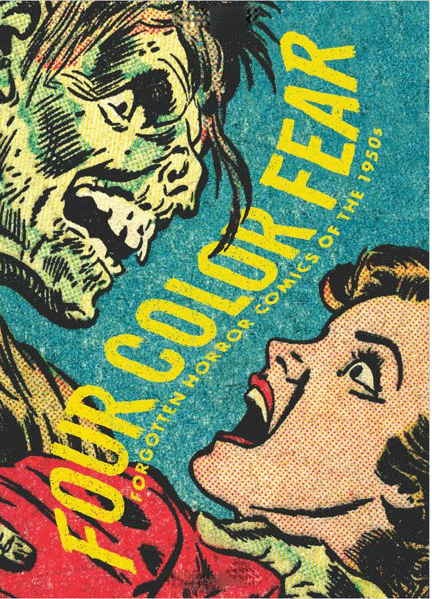
So in the past few months I have been devouring two wonderful trade paperbacks that not only give the history of the Golden Age of horror comic books, but also reproduce many of the best stories, in garish color.

The first volume is called THE HORROR! THE HORROR!  COMIC BOOKS THE GOVERNMENT DIDN’T WANT YOU TO READ by R.L. Stine and Jim Trombetta (Abrams ComicArts, $30).  This is one of those lush, full color, oversized trade paperbacks that simulates the case bound look and feel of a dust jacket by having the heavy-stock cover fold back underneath.  The book contains tons of text detailing the history of horror comic books, and perhaps too much space is devoted to reprinting sample two-page spreads from some wonderful stories where we wish we could read the entire comic.  Lots of comic covers are reproduced as well.  But the entire purpose of the book is reproducing entire comic stories in their entirety and this becomes the chief strength of THE HORROR!  THE HORROR!  Even the reproduction reflects the age of the comics with yellowish paper now replacing pure white. Even some of the flaws of aging are reproduced as well.  The book’s layout and visual audacity is beautiful, worthy of winning a graphic design award, but somehow all I wanted was to read the comics stories themselves.  No need for interviews, historic significance, facts, etc.  The comic art says it all.

Which is why the slightly smaller and less flashy counterpart FOUR COLOR FEAR:  FORGOTTEN HORROR COMICS OF THE 1950s, edited by Greg Sadowski (Fantagraphics Books, $30), is the superior book in my estimation.  Even though the paper stock is slightly thinner, the volume is still in full color and attractively designed.  But the reason why FOUR COLOR FEAR has the edge is simply because the book literally piles complete full-color horror comics one after the other.  And it appears that all the strips have been digitally cleaned up to make them appear brand new with colors that pop out at us.  For me the glossy center section that reproduces front covers of comics is not essential.  Just presenting complete comic stories is the essence of what makes both these books essential.

And to be honest, entering the world of comic book horror circa the early 1950s is a rather rude awakening.  First, and most surprising, is the fact that most of these comic stories are not actually geared for children, at least not the eight-year-old variety.  This world is one of damnation and redemption and fosters an Old Testament morality.  The principal characters are scientists, newlyweds, henpecked husbands, sexily attired femme fatales who appear as wives and girlfriends.  The stories often start with or feature a recurring dream, mostly nightmares, and they deal with the most unusual things.  Funeral parlors are on strike so corpses cannot be buried and they literally keep piling up.  For health reasons, nothing like this would be allowed to occur in real life, so perhaps this is the juvenile aspect, as children would accept all these ludicrous scenarios.  In these stories we enter the world of the carny, of the undertaker, of people who indulge in vices such as gambling and high stakes poker games (playing for one’s life is the norm in this world).  In stories such as “The Corpse That Came to Diner,” a newlywed couple is haunted by the suicide death of the wife’s rival for her love, who returns from the grave a ghoulish, rotting corpse and refuses to leave the lovers alone.  Of course there is a surprise twist at the very end. In other stories people make pacts with the devil and lose.  People sacrifice everything to achieve their life’s dream scientific discovery, only to find out that discovery is death.  In another story a murderer is haunted by the dead, rotting corpse of the man he killed, who no matter where the body is dumped, it always returns to the murderer’s room.  In a haunting yet ridiculous story, “The Brain-Bats of Venus,” we have flying pink monsters become the controlling brains of dead human corpses. These creatures sit on their now dead hosts’ human heads.  While the premise is silly, the story chills the bones and images of human corpses being maneuvered by blob monsters with tentacles is one for the ages.  And such audacity continues story after story, comic panel after panel.

In this pre-code comic book world, human victims are consumed and destroyed by any number of the Seven Deadly Sins.  Women are generally manipulative, seductive or downright evil.  Or, they play the other extreme, becoming the ideal trophy wife.  Men are punished physically and mentally for their indiscretions, and in this moral universe, there is no escaping punishment for crimes or sins committed.  Often the final panel is shocking, with rough justice being doled out by the bucketful (of blood).  In such a comic universe, no one gets away with bloody murder and instant Karma levels the playing field in often the most shocking, surprising and gruesome ways.

I must admit that I enjoyed THE HORROR! THE HORROR! And FOUR COLOR FEAR more than I believed possible.  I mean, these are stories 60 years old from comic books created for children.  But man, as an adult these stories still pack a wallop and their ironic sense of justice still brings both a shudder and smile to my intense eyes glued to each panel. No E.C. titles are included in either volume, but these second tier comics are the real deal!  Sit back, take your time (let that inner child out for a breath of fresh air) and enjoy!

Sunday, July 31, 2011

DEAD HOOKER IN A TRUNK: Deliciously Outrageous!


My wife Sue is now a regular columnist for FANGORIA, writing “Furious Femmes” every month, a column about women who make horror movies.  And of course Sue has been interviewing many of the women filmmakers and getting copies of their movies.   

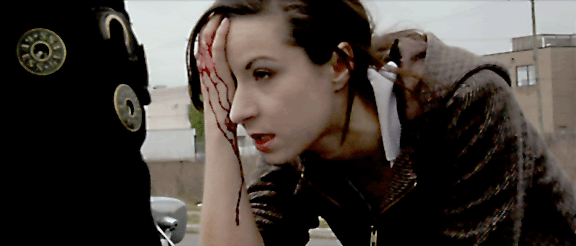
Vancouver twins Jen and Sylvia Soska have made their debuting feature DEAD HOOKER IN A TRUNK and it is total bliss cinema.  This film reminds me a great deal of the early, gonzo John Waters productions (during his PINK FLAMINGOS and FEMALE TROUBLE period), except the Soska film has better acting.  Every character is a stereotype (called Junkie, Geek, Badass, Goody Two Shoes) and the performances are either gritty/tough or wistful/tender, but every performance seems committed and real.  We believe in these rejects and ultimately come to care about them, as difficult as that may seem.  In this production, everyone rolls up his or her sleeves and pitches in.  Jen and Sylvia Soska star, write and direct and many of the other cast members (particularly C.J. Wallis) perform multiple duties.  And they all do wonderful jobs.

What I like is that this is a movie that could only have been made by young artists.  And I say this not because most of the cast is young, the action occurring at punk rock clubs and places where young folks frequent, and the musical score consists of buzz-sawing metal and punk rock.  Old farts could film young performers at a club and use a blaring rock score.  That’s not the point. But the film is filled to the brim with youthful enthusiasm, brashness, audacity and the Soska sisters do stuff that might seem silly or illogical in the hands of more seasoned professionals.  But they pull it off!  And who but the young would put themselves so far out there!


For instance, what mainstream or even cookie-cutter B production today would include the following sequence of events?  Geek (Jen Soska) is attacked from behind, pushed forward hard which knocks one of her eyes from the socket.  Her attacker bends down over her to make sure the eye is gone (it lies in a bloody heap to her side).  Geek picks herself up and holds her hand over her eye socket as blood flows down her hand and arm.  Soon she is declaring to her friends, calmly, all she needs are a few supplies, including two pieces of crisscrossing black tape to cover her eye socket, to fix her up.  In another sequence Junkie, who is nursing a slashed arm from a recent attack, is waving her arms while ranting, standing out in the street, when an 18-wheeler speeds past her ripping her wounded arm off.  Picking up the severed arm, her friends use tape and a needle and thread to reattach the arm, at least long enough to get Junkie to the hospital (which eventually occurs only after she drives herself to the emergency ward). Get the picture, outrageous stuff occurs at any moment and such cartoon violence is played straight.  Yet in another sequence, the one that explains how the hooker got to be dead before being stuffed into a car trunk, we watch as the killer brutally beats and then prepares to rape the hooker.  Such a sequence is difficult to watch and demonstrates how ultra-violence against women is one of the major themes of Soska cinema.  But we have such ping-ponging changes in tone, between goofy gore and violence and savage, disturbing female abuse.  But such diverse shifts prove to be interesting.

We have a constant barrage of running gags and homages to other movies thrown in for good measure.  For instance Badass (Sylvia Soska) is the one who is never wounded or hurt, while others around her lose their eyes, arms and Goody Two Shoes (C.J. Wallis), the Jesus freak who runs a church youth group, constantly bends over and vomits whenever the going gets tough.  So it is shocking, near the end of the film, when Badass returns to her apartment and is surprised by the killer-who-wears-a-hood who brutally punches her unconscious and subdues her by placing a plastic bag over her head.  When she awakens from this brutal attack, she recognizes her attacker immediately, a character we remember from earlier in the movie.  But just when we are lead to believe that Badass is indestructible, we now see her as vulnerable.  But earlier, in what I consider homage to Sam Raimi’s EVIL DEAD, we have Badass shoot the man who just disemboweled a drug dealer, his attacker slicing through his stomach and fondling his bleeding and now exposed intestines.  To put the pathetic dying man out of his misery, Badass thrusts her gun directly near the camera as we focus on her face.  We never see the man she shoots; instead, we hear the gun explode and see blood spattered all over her face in a quick instant.  This reminds me of similar sequences in EVIL DEAD where Ash (Bruce Campbell) has blood spattered all over his face.

Lastly, what I admire most about DEAD HOOKER IN A TRUNK is the manner by which the Soska sisters tell their story visually, opening the movie with a gonzo tracking shot that introduces both characters and the action with a minimum amount of dialogue for roughly the film’s first 10 minutes.  The movie opens as a girl arrives at the punk rock club in her car, jumping out of the car and running up the stairs to the club.  In an intimate surrounding, we see Junkie scream her little punk heart out as important characters either dance, speak in the shadows or walk past as we pan left or right.  We see a brief glimpse of the hooded killer, we see the strangely alive hooker wearing the red dress with side slits who will soon be dead (and the Soska sisters include a quick shot forward in time showing the hooker with a bloody punched face before we cut back to show her now smiling), we see the frightening Cowboy Pimp and other characters who only become important as the movie pushes ahead.  But with the blaring musical score, the quick cuts, stationary camera work alongside hand-held jerkiness, the movie impresses with a dramatic and totally visual (and auditory) introduction.  Fortunately this is only one of many “money” shots spread throughout the movie.

Yes, if we wanted to focus on flaws we could find them.  Hey, this is independent filmmaking at its most raw level.  DEAD HOOKER IN A TRUNK is more a labor of love emphasizing the joy of expression than it could ever be considered a commercial venture.  The Soska sisters, if they continue to hone their technique, will only make bigger and hopefully better movies.  Just as “Silent Bob” rose from independent to mainstream cinema, I hope to see the characters of Geek, Badass and Goody Two Shoes develop in future Soska movies. But for a debut, DEAD HOOKER IN A TRUNK is a film that lingers long after the music fades away and the credits fade to black.  This is a movie to seek out and enjoy, warts and all. 


Sunday, July 24, 2011

BORDERS CLOSES ITS DOORS: Is The Death of the Brick and Mortar Book/Music Store Upon Us?


I love bookstores almost as much as I love music stores.  Growing up I would often take a bus downtown (about a 45 minute ride) to go to General Records, an infamous downtown record store that carried all the albums and 45-rpm singles that mainstream record stores never carried.  I purchased albums such as the Jeff Beck Group’s TRUTH and THE ROD STEWART ALBUM, when Rod-the-Mod was a degenerate rocker, even before The Faces reformed around him. Most of the time I did not know what was newly released, so going through the vinyl bins made discovery exciting.

The same was true with bookstores.  I would gravitate to the magazine section or the movie or music book sections.  I even checked out some fiction.  But the anticipation of finding something fresh and original fueled my journeys.  And it was a tactile, hands-on experience!

But in those days that was the only way to find books, music and magazines. 

I have to admit when the Internet began to publish the release dates of upcoming music CDs and books, the discovery aspect of going to brick and mortal shops was greatly diminished.  Why take the time and spend the gas to travel a great distance to perhaps find something I wanted when the purchase of that specific book or record was one click way at home?  Also, for most Internet sales you may pay shipping but mostly you never paid sales tax.  And you save on gas and time.  There’s never enough time!

True, it never has been quite as much fun searching out books, magazines and CDs/downloads online as it was venturing to overstuffed and crowded shops with other fans that loved what you loved, intermingling with knowledgeable, enthusiastic salespeople (who usually were fans themselves).  But searching online or in person is still searching (and think how easy it has become to sample the first few pages of a potential book buy or how convenient to hear sound samples of new albums, privately, online).

The bottom line is this.  The way people read and listen to music today has changed, so the manner in which we browse, sample and buy has also changed.  As electronic gadgets such as the iPod, iPad, Smartphone and other devices steal shelf space formerly devoted to books and CDs, shopping online has become more and more important and, dare I say, necessary.

For instance my friend Paul Krueger does not own a computer, and by the time he gave up trying to find the newly released Blu-ray of THE EGYPTIAN in brick and mortal stores, the movie was out of print (it was limited to 3,000 copies).  For those of us who shop the Internet (and especially Amazon.com with their PRIME shipping and free download of DVDs), we can buy literally any movie, magazine or book that is in print, no matter how small its niche market or limited edition it may be.  EVERYTHING out there, even self-published or home garage record label releases, can be purchased, and most at very affordable, discounted prices.

Right now The Criterion Collection DVD/Blu-ray movies are 50% off list price at Barnes & Noble.  Of course I can drive to the nearest one, fight the traffic, spend the gas and walk a long distance to perhaps find that the movie I wanted to buy was not carried at this particular store or simply sold out.  Or I can access Barnes & Noble online, search out any movie I want to buy, even the ones that are temporarily out of stock, and have them delivered to my home at the 50% discount.

Perhaps I am getting old, but the convenience and sampling of unlimited titles is more and more appealing.  The fact that books and music are always sale priced and I never buy any book or CD/music download at list price is also very appealing.  And with Amazon.com Prime I pay $80 a year but get most everything shipped guaranteed second day shipping.  I can’t do better than that!  I make that $80 back by the third month and then ride the free wave the remainder of the year.

I always hated going to Best Buy on the Tuesday that a new DVD was released.  The major blockbuster titles were always there.  But sometimes when an older release came out, a so-called classic, the salesperson would check the shelf and say, wait, we may have copies “in back.”  Most times he would return empty-handed and state, sorry, it will most likely be on the truck Thursday, if not, it will definitely be here next week, or guaranteed the following week.  And of course I was expected to constantly be driving back to see if the film that should now be in my sweaty hands had arrived.  Of course the store only ordered 5 copies at most, so unless I got there early upon arrival, that title might sell out for good. Why waste time and energy!! I order the movie from my computer today and have it in my anxious hands in two days (or one day if I am lucky, which frequently occurs).

I admit I am sad when brick and mortal shops close.  I have fond memories of going to my favorite book and record shops over the years, and often I remember buying a specific Bob Dylan album at a specific store at a special time of the year.  But I also mourned the passing of the milkman delivering milk and juice to the front door.  I mourned the loss of going to the soda shop to buy freshly made sodas and milkshakes.  I mourned the loss of deejay-controlled radio stations. I mourned the passing of those fresh produce carts pulled by horses in the city where salesmen (here in Baltimore they were called “Arabbers” with an accent on the “A”) would yell out their stock and trade as they crept down the block.  And yes, I mourned the loss of the neighborhood ice cream man whose jingle-jangle merry melodies would beckon all the kids in the neighborhood outside on a warm summer night.  I mourned and continue to mourn all of that.  But change is inevitable and sometimes even for the best.

Anyway we look at it, we can still buy ice cream, milk, produce, books, magazines and music.  We just have to adapt to new ways of purchasing the old familiar.  And I won’t even talk about reading books on my Kindle or walking Buddy down the street listening to music on my iPod Classic.  That’s a story for another time.

Saturday, July 16, 2011

STELLAR QUASAR AND THE SCROLLS OF DADELIAN begins filming at MONSTER BASH


Welcome Back to the NEW and REVISED Gary J. Svehla’s Blog for Midnight Marquee and Mad About Movies.  Instead of using our website to update the Blog, we have decided to use Blogger from Google which makes updates faster and easier, and it creates a better visual sense.  We have included Archives (from 2007, 2008, 2009 and 2010) of every Blog we ever posted and each year’s Blogs are one click away.  The Blogs for 2011 are current and I even added a new Best DVDS of 2010 posting.  Hopefully, I will be able to Blog more frequently.  Please enjoy my rants and raves and comments may be sent to midmargary@verizon.net.   


Besides accessing this blog from our website
http://www.midmar.com and clicking on the "Gary's Blog" link,
you can also access the blog at the following URL
http://midnightmarqueeblog.blogspot.com

 
Cult Star Icons Veronica Carlson and Caroline Munro as the Oracles

MONSTER BASH is the only current classic horror film convention operating, and Sue and I (and our dog Buddy) traveled to Butler, PA to socialize with friends such as Nancy and Dick Klemensen, Steve Vertlieb, Wes Shank and wife Judy, Robert Tinnell and many others. Many attendees asked to be photographed with Buddy, and children were most concerned when we appeared on the convention floor without our companion.

Our third feature film, tentatively titled STELLAR QUASAR, goes into full production at the end of the month.  Unlike TERROR IN THE TROPICS and TERROR IN THE PHARAOH'S TOMB, STELLAR QUASAR is a science fiction "quest" movie with tons of green screen photography and digital special effects.  Sue, who wrote the screenplay and is directing once again, loves science fiction movies and this is the film she seems most jazzed about.
To beef up interest and to honor our cinematic heroes, we knew that former FANEX guests Veronica Carlson and Caroline Munro would be appearing at the BASH.  Working with another friend and sponsor Kevin Flynn, we arranged for the ladies to play outer space Oracles that deliver the biting message at the climax of the movie.  Hiring a student crew headed by Robert Tinnell, their film school teacher and director of the movie FRANKENSTEIN AND ME, the sequences were shot by Nicholas Carrington with assistance from Jason Walker.  Tinnell offered Sue technical advice while she directed.  It was a virtual lovefest!


 Our lovely ladies wore intensely colorful and sparkling costumes, designed by Sue for the sequence, and after setting up the portable green screen, the filming commenced as the professional attributes of Carlson and Munro blazed through.  Their expressions, movement and line readings were impeccable.  And remember, we were filming in a hotel room under compromised circumstances.  But our actresses did themselves proud and we felt honored and blessed by their participation in our modest production.

The very next day Sue and I met our friends Wes Shank and Judy, owners of the original Blob, and Wes graciously invited a small crew to come up to his home museum later in the summer to film a few sequences.  These sequences will focus upon several of his actual movie props to add class, history and budget to the production.

So even before the actual production begins, we are finding success and help in many different ways, from so many friends.  As the shooting begins, we will be posting photos and the latest reports.

Richard Klemensen, Steven Thornton; Buddy; and Gary J. Svehla at the Bash
 

DVD/BLU-RAY TOP-10 LIST: Best of 2010


 I fast discovered that every year since I started doing my Blog that fewer and fewer classic horror, science fiction and crime/noir titles are being released.  Why?  Well, the best ones have already been released.  Now distributors seek out the remaining few classics and the dribs and drabs of the near classic or the obscure.  That means that more and more of the made-to-order Warner Archive Collection will make my top-ten list each year, and fewer and fewer mainstream releases will appear.

Even if we are dealing with more B productions and the obscure, there were still many incredible films released to DVD and Blu-ray this past year. 

Here is my top-10 list in no particular order!

THRILLER:  THE COMPLETE SERIES 
My absolute favorite DVD of the year has to be Image Entertainment’s release of the entire two-year run of THRILLER, the classic anthology series hosted by Boris Karloff.  As a child I thrilled to classic horror episodes such as The Hungry Glass, Pigeons from Hell and The Cheaters.  But as seen today in its entirety, I find myself gasping at how good the series was, even the majority of the suspense/crime episodes.  And many supernatural-oriented episodes, the ones not usually referenced, as often excellent as well.  As I take my time and watch all 67 episodes, I am entertained, terrified and riveted.  And I am shocked at just how many episodes I am seeing here for the first time.  Truly a revelation and a treasure trove of pleasure! 

VAMPIRE CIRCUS
Hammer was on its last legs in 1972 when VAMPIRE CIRCUS was released. Not classic in terms of either production or presentation and lacking creative input from any of the original Hammer auteurs (Tony Hinds, Michael Carreras, Terence Fisher, James Bernard, Roy Ashton), the movie still shines.  Strangely mystical and almost made as a horrific fairy tale, VAMPIRE CIRCUS is rather audacious for the time, presenting vampires as a plague that haunts a small traveling circus and lures victims into the deadly Hall of Mirrors, where all enter but not everyone leaves.  This Blu-ray presentation is magnificent, presenting the original vibrant color hues and deep contrast missing from the film since its original theatrical release (which was cut in the U.S.).  VAMPIRE CIRCUS today seems rather old school featuring classical vampires with elongated fangs, but for Hammer, the movie was a totally new take on an old Hammer chestnut.  And it is one fine horror movie that now looks and sounds gorgeous.

PSYCHO
Alfred Hitchcock’s PSYCHO was the master’s slumming, low-rent masterpiece.  Coming after the ornate NORTH BY NORTHWEST, PSYCHO seems like an after-though B production.  However, as presented re-mastered anamorphically in Blu-ray with digital sound, Hitchcock’s imagery and creepy soundscape (punctuated by the classic Bernard Herrmann musical score) approximate crisp 35mm projection.  For once we can appreciate all the deliberate cinematography that Hitchcock mastered by this point in his career—Norman Bates surrounded by his stuffed birds; Martin Balsam’s overhead attack by Norman’s “mother” and his slow glide fall backwards down the steep staircase; the infamous shower murder sequence; the overhead light swinging to and fro as the corpse of “mother” is revealed; the sun-glassed cop’s cold, piercing eyes staring at the just-awakening Janet Leigh, as she rises up in her car.  The list goes on and on.  But the Blu-ray restores a classic vision to a formerly well-worn masterpiece.

THE CAT AND THE CANARY (1939)
While only available as part of the Bob Hope: Thanks for the Memories Collection, this first-time ever DVD release of Bob Hope’s seldom seen horror classic THE CAT AND THE CANARY looks terrific restored as best as possible for any movie originally released in 1939.  While THE GHOST BREAKERS has been available on home video for a long while, THE CAT AND THE CANARY has always been missing in action.  And the movie is the perfect compliment to the other Hope chiller, featuring horror film icons George Zucco and Gale Sondergaard in delightful roles, excellent sets and designs featuring a haunted swamp-side mansion with secret rooms and nighttime boat rides down a fog-shrouded river.  And Bob Hope brings his comedic style to every sequence.  Perhaps the film’s puffed-up reputation makes fans expect too much, but nonetheless, THE CAT AND THE CANARY is a marvelous film too long missing from home video.

STRANGER ON THE THIRD FLOOR
Many consider STRANGER ON THE THIRD FLOOR to be the first film noir, while others see it as a visually adventurous suspense film featuring a knife-wielding psycho (played deliciously by Peter Lorre).  Bottom line, it is one of the best RKO B productions ever made, one featuring a cabbie wrongfully accused of robbery and murder (slicing the victim’s throat from ear to ear) and the attempts of regular people to discover the truth.  Peter Lorre as the “stranger” is creepy and becomes classic early Lorre, with those sad eyes and tentative delivery of dialogue (even buying raw hamburger for his dog becomes off-putting).  The movie contains such powerful symbolic visuals that approximate dream reality and hold audience attention.  Finally made available as a made-to-order Warner Archives release, STRANGER ON THE THIRD FLOOR is a must-see film for horror, noir and Peter Lorre fans.

ICONS OF SUSPENSE:  HAMMER FILMS
Now that all the Gothic color Hammer classics have been released, as well as a host of not-so-classic releases (THE MAN WHO COULD CHEAT DEATH; THE TWO FACES OF DR. JEKYLL), as well as their pirate movies and other odd productions, it is about time that the black and white psycho thrillers and other overlooked titles are finally seeing the light of day.  This collection contains THESE ARE THE DAMNED, one of the finest pre-atomic war fear films ever concocted (featuring an art film sensibility and a catchy rock’n’roll theme song).  Wonderful suspense thrillers THE SNORKEL and MANIAC are included, with perhaps the rare but mediocre STOP ME BEFORE I KILL also included.  NEVER TAKE CANDY FROM A STRANGER is at last released, another excellent story of a small village pervert (with privilege and wealth that protects him) who preys on young girls.  But the gem of the set is CASH ON DEMAND, a heist thriller starring Peter Cushing in one of his finest roles, playing a prissy bank manager.  And along for villainy is a steely-eyed Andre Morell.  For me finally seeing the extremely rare CASH ON DEMAND was the treat of the collection, and seeing Peter Cushing create another first-rate performance is worth the price of admission. 

GORDON SCOTT TARZAN COLLECTION:
For years fans have been clamoring for the release of the fan-favorite Gordon Scott Tarzan movies, released between 1955 and 1960.  Fans and critics alike have called Scott’s final two entries, TARZAN’S GREATEST ADVENTURE and TARZAN THE MAGNIFICENT, two of the best Tarzan entries ever produced, and they are indeed just that.  In this Warner Archive made-to-order release, it is a shame that these films could not have been given a full restoration and digital cleaning, but as seen here, the color saturation is deep and the black and white entries have good (if not great) contrast.  For me Gordon Scott was the greatest Tarzan of them all and these six films remind me of going to the theater to see most of them as a small boy with my father. When it comes to iconic heroes of the baby-boomer generation, the well-chiseled physique and down to earth kindness of this king of the jungle, Gordon Scott, will continue to linger for generations in the imagination of children everywhere (and adults as well).

NIGHT OF THE HUNTER
When it comes to the scariest of non-horror cinema, NIGHT OF THE HUNTER, the only film directed by Charles Laughton, contains some of the most terrifying cinematography ever to grace a suspense thriller.  Add to that Robert Mitchum’s second greatest psychopathic performance (his twisted reverend here is one notch below his Max Cady in CAPE FEAR, in my estimation) and we have a true classic.  In this Criterion Blu-ray restoration, the movie shimmers with his excellent contrast black and white photography.  The sequence with Shelley Winter’s body sitting in that old jalopy underwater, dead, has to be one of cinema’s most iconic sequences.  And in the final quarter when the children are on the run, sleeping in barns and racing down the river in a rowboat, the film mesmerizes.  Perhaps the ending lacks the emotional rush audiences were hoping for (for me the film’s main flaw) as Mitchum’s villain receives a rather un-dramatic comeuppance.  But NIGHT OF THE HUNTER is classic in every sense, with gorgeous cinematography, and Robert Mitchum commands the screen.

WHITE CHRISTMAS
I never truly enjoyed WHITE CHRISTMAS until I saw it through Susan’s eyes.  While many fans enjoy HOLIDAY INN more than this one, in recent years the tide seems to be turning.  And having watched the film year in and out, now I know why.  The splendid, lush VistaVision image, bathed in Technicolor hues, containing wonderful performances by Bing Crosby, Danny Kay, Vera-Ellen and Rosemary Clooney warm the heart.  Now available in Blu-ray, the film visually dazzles more so than ever.  WHITE CHRISTMAS is the equivalent of warming winter comfort food.  Yes, the script is easily predicted but the performances colored by the musical production numbers win us over.  This is one Christmas film that I can watch over and over again, and it never fails to bring a smile to my lips.  And now, the film has never looked or sounded better.

COLUMBIA PICTURES FILM NOIR CLASSICS, VOL. 2
Generally, the quality of Volume 2 of any DVD collection is inferior when compared to Volume 1, but with the Columbia Pictures initial box set of film noirs, I was rather disappointed.  Of course Columbia produced the B noirs, the low-rent movies that never garnered the attention of the higher profile Warner and Fox releases.  However, Volume 2 kicks Volume 1 to the mat with infinitely superior movies.  The most fun occurs because viewers probably never saw the majority of the films contained within these Columbia noir sets; It’s always exciting to ponder films unseen for the first time.  In Volume 2 are treated to solid crime dramas such as Jacques Tourneur’s NIGHTFALL and Fritz Lang’s HUMAN DESIRE.  We also have Fred MacMurray’s PUSHOVER, the other film besides DOUBLE INDEMNITY that shows MacMurray consumed by lust, becoming another tragic idiot whose internal flaws destroy him.  But the ace of the deck has to be THE BROTHERS RICO, a film that foreshadows family mob films such as THE GODFATHER.  And Richard Conte delivers a bravura performance that impresses long after the final end credits appear.  For me seeing each of these films for the first time was a real treat.